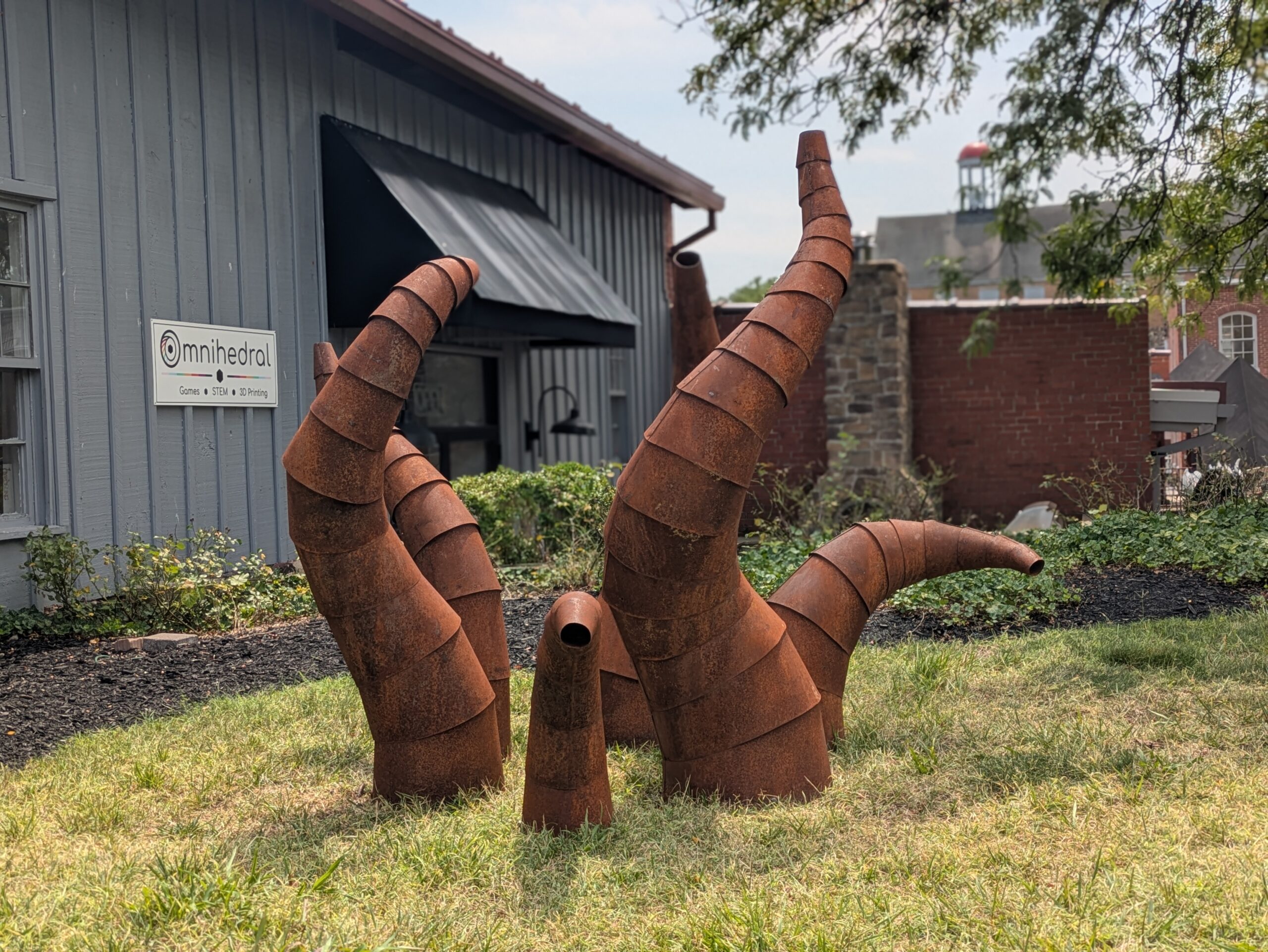
This spring, Savage Mill was selected to host a large outdoor sculpture for the 2026-2027 Howard County Arts Council’s ARTsites program. Then came the “draft”, an exciting virtual meeting in which each of the twelve locations worked with the Arts Council representative to choose “their” piece from among dozens of entries by sculptors near and far. “Searching,” a piece by local sculptor Nick Femia, was one of our top choices, and the news that we’d be receiving it generated enthusiasm among Mill management. We even had the perfect spot in mind for it, a prominent corner in front of Omnihedral Game Store near the Little Lot entrance.
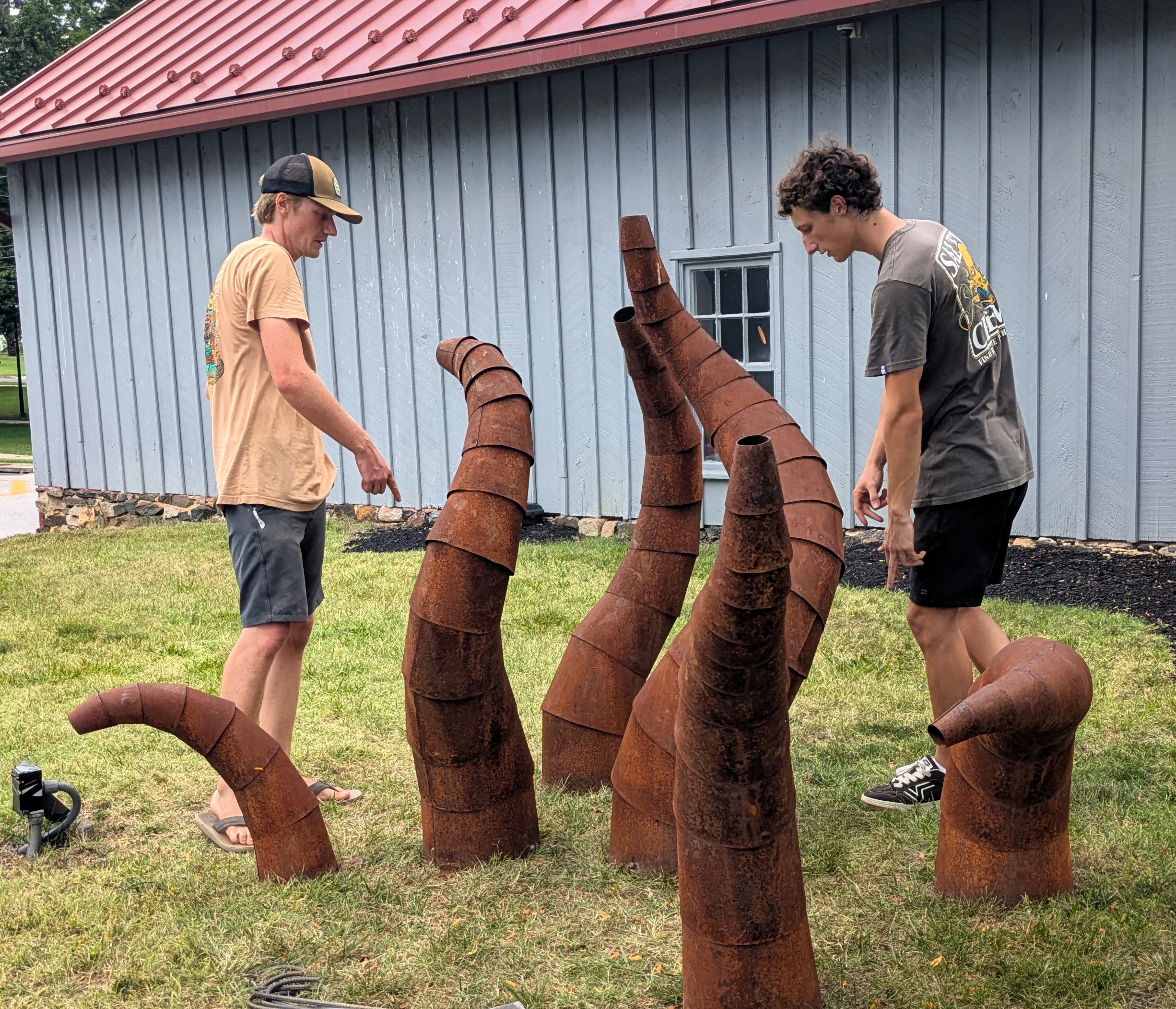
Nick (left) and his brother installed “Searching” a couple weeks ago, working together to position each component in correct alignment with the others and to ensure harmony with its surroundings. We spoke with Nick to learn more about the piece, his practice, and the sources of his inspiration.
When did you know that you wanted to become an artist?
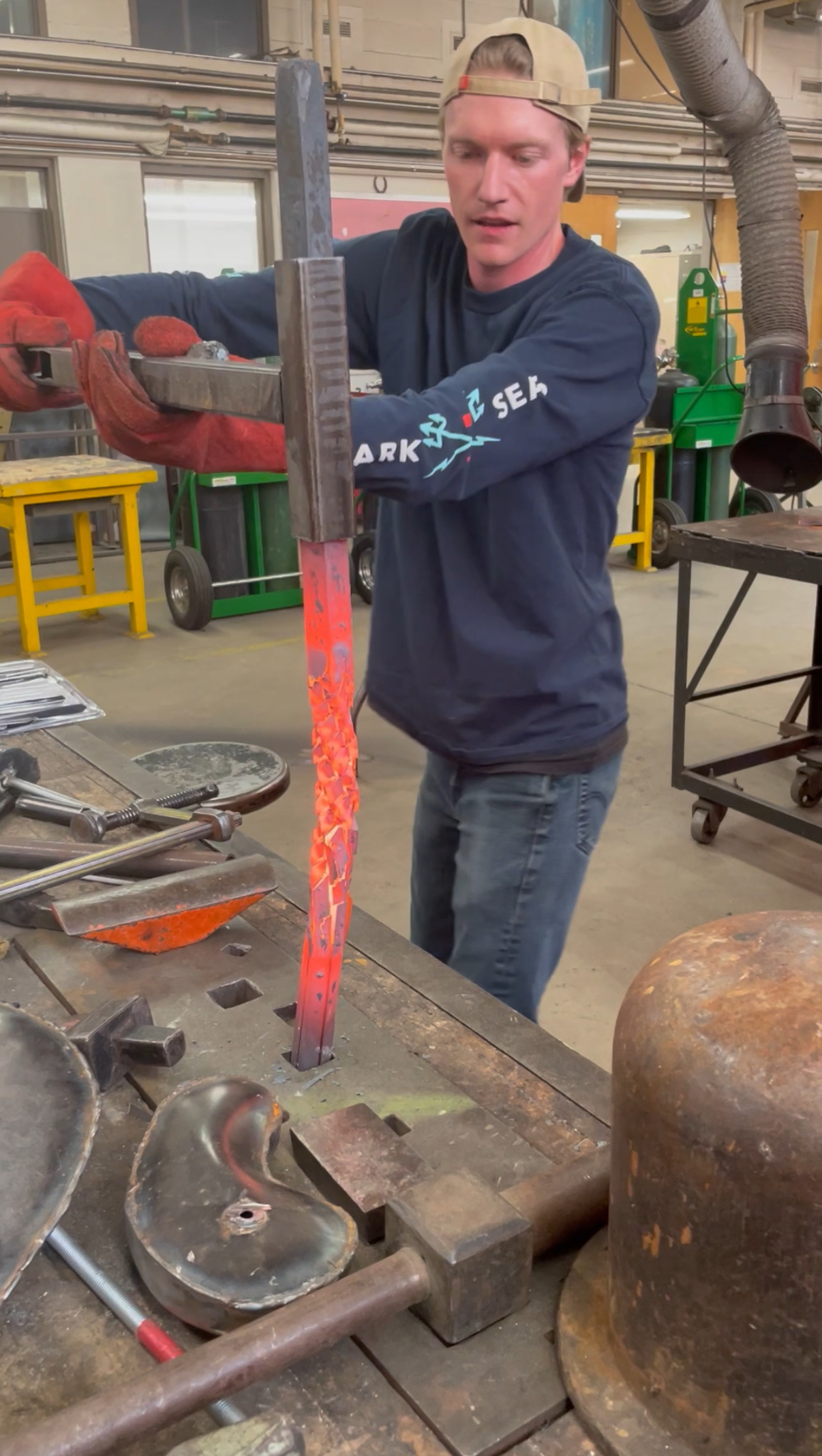
I’ve always been drawn to making things, whether they were artistic or not, but I would say I first began seriously considering art as a career around 2014, when I started making skateboards. I wasn’t just painting the decks, I was also laminating and shaping them myself. That process of combining form and function really appealed to me. I enjoyed the idea that something could be both visually compelling and serve a practical purpose, and that experience ultimately played a major role in my decision to pursue a career in the arts.
There’s a link to a construction company on your Instagram account. Do you have a background in construction that has shaped how you look at the world?
Yes. I grew up around construction sites and have worked for my family’s small construction company for many years. That experience has had a significant influence on the way I approach art, particularly sculpture. Being exposed to construction from a young age taught me to appreciate materials, structure, craftsmanship, and the relationship between form and function. It showed me that something designed with intention can be both useful and beautiful, and that thoughtful design has the ability to enrich the spaces and experiences around us.
What are some geometric forms in nature that initially fascinated you?
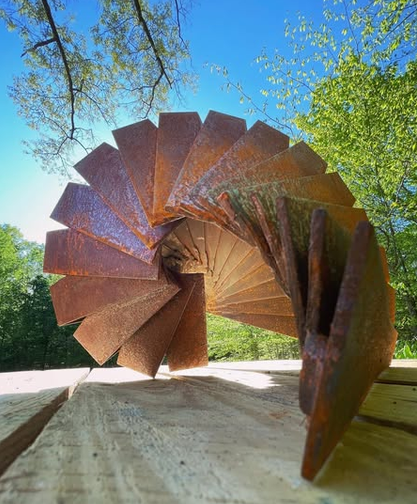
I’ve always been drawn to spiral and wave-like forms. Interestingly, they tend to appear throughout my work, both sculptural and graphic, even when I’m not consciously trying to incorporate them. I think there is something naturally compelling about the movement and rhythm of these forms.
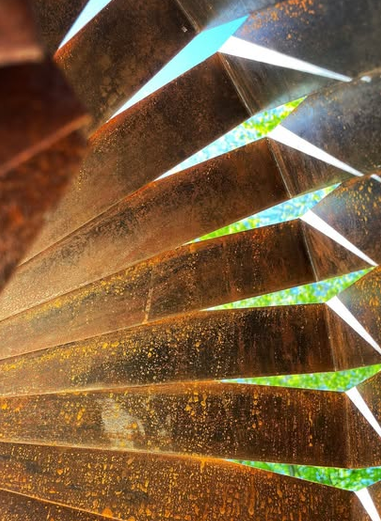
“Searching” is reminiscent of an octopus. Is that intentional?
No, “Searching” wasn’t intended to represent an octopus or any particular object, for that matter. One of my favorite aspects of the piece has been seeing how differently people interpret it.
The original concept was actually quite different. I initially planned for the forms to be connected and incorporate a smoke element, allowing them to function almost like chimneys, with smoke emerging from the tops. As the work developed, the forms became individual sculptures instead. Interestingly, I now tend to see the piece as resembling flames, but I enjoy leaving that interpretation open to the viewer.
“Searching” has been traveling around the area, and was on display at the Hill Center in DC prior to coming here. How do you decide which piece to enter into a public art exhibition program?
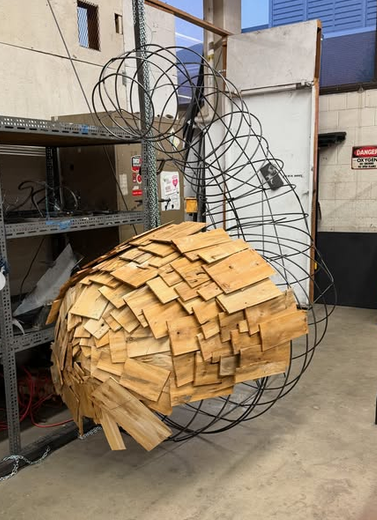
It really depends on the site and the theme of the exhibition. I consider how a particular sculpture will interact with its surroundings and whether its scale, material, and form are appropriate for the environment. Because my work is often about the relationship between sculpture and space, I’m especially interested in opportunities where the site can become part of the work rather than simply serving as a backdrop.
What are some things you hope people take from your work?
With my sculptural work, I hope people become more aware of how a piece can transform the character of a space. I’m particularly interested in placing sculpture in everyday environments that might otherwise go unnoticed and using the work to give those spaces a new sense of energy or identity.
You’re working on a BA in Studio Arts and Graphic Design at the University of Maryland. As part of that, you’ve done design concepts for exciting events like the 2028 Olympics. What do you hope comes from that?
The Olympic design project was a school project that I’ve continued to develop as part of my design portfolio. Graphic design was actually what initially led me to pursue a university education in the arts, and I still see it as an important part of my creative practice.
I graduated in the spring, and I’m currently looking for opportunities that allow me to bring together my interests in sculpture and graphic design. As technology and AI continue to reshape the graphic design field, I’ve become increasingly interested in work that combines digital design with physical, three-dimensional experiences. Environmental design feels like a natural direction for me because it allows those two disciplines to work together using graphic design, sculpture, architecture, and the surrounding environment to create cohesive experiences.
View this post on Instagram
Are you currently working on another sculpture?
I have several ideas for sculptures that I’d like to develop in the near future, including one that would be closely related to “Searching.” At the moment, though, I’m focusing on designing murals for several parks in Fairfax, Virginia and am also assisting with several exhibit installations throughout the DMV.
Learn More about Nicholas Femia here.